
If you are exploring real estate in Colombia—whether renting an apartment in Medellín or purchasing an investment property in Envigado—you will encounter the term “Estrato” almost immediately. It appears on property listings, municipal tax documents, and monthly EPM utility bills.
While international buyers often mistake the estrato system for a personal social credit rating or an income bracket, it is actually a property-based socioeconomic classification system. Created under Law 142 of 1994, Colombia’s estrato system uses a cross-subsidy model to fund public utilities across urban and rural municipalities.
Understanding how estratos work is essential for calculating accurate monthly carrying costs, evaluating rental yields, and choosing the right neighborhood for your lifestyle or investment portfolio.
1. What Is an Estrato? (The Core Principle)
In Colombia, every residential building is assigned a designated stratum ranging from Estrato 1 to Estrato 6.
The Golden Rule of Estratos:
The estrato is attached to the physical property and its surrounding infrastructure—never to the resident.
Your income, net worth, nationality, or employment status have zero bearing on a property’s estrato. A billionaire living in an Estrato 3 apartment pays Estrato 3 utility rates, while a student renting a room in an Estrato 6 tower pays Estrato 6 utility rates.
Municipalities assign estratos based on physical urban criteria, including:
- Quality of road paving and sidewalk infrastructure.
- Building construction materials and exterior finishes.
- Access to public parks, street lighting, and municipal services.
- Surrounding urban density and terrain.
2. The 6 Estrato Tiers & Utility Tariff Mathematics
The primary function of the estrato system is to determine public utility billing (electricity, water, sewage, and natural gas). The system operates on a mechanism called cross-subsidization: higher-stratum properties pay surcharges that subsidize the utility costs of lower-stratum households.
| Estrato Level | Official Classification | Utility Billing Impact | Example Neighborhoods (Medellín & Aburrá Valley) |
| Estrato 1 | Bajo-bajo (Lowest) | Subsidized (up to 50%–70% discount) | Outer rural edges, informal settlements |
| Estrato 2 | Bajo (Low) | Subsidized (up to 40% discount) | Aranjuez, Manrique, parts of Bello |
| Estrato 3 | Medio-bajo (Lower-Middle) | Subsidized (up to 15% discount) | Sabaneta, parts of Envigado, Belén |
| Estrato 4 | Medio (Middle) | Neutral (100% standard base rate) | Laureles, Estadio, central Envigado |
| Estrato 5 | Medio-alto (Upper-Middle) | +20% Mandatory Solidarity Surcharge | Lower El Poblado, Loma de los Bernal, Zúñiga |
| Estrato 6 | Alto (High) | +20% Mandatory Solidarity Surcharge | El Poblado (Provenza, El Tesoro, San Lucas) |
The “Neutral” Tier (Estrato 4)
Estrato 4 is the baseline reference point. Residents in Estrato 4 pay the exact cost calculated by the utility provider (such as EPM in Medellín) with zero subsidy and zero surcharge.
The “Solidarity” Surcharge (Estratos 5 & 6)
In Estratos 5 and 6, utility invoices include a mandatory 20% solidarity contribution (contribución de solidaridad) added directly to the cost of electricity, gas, and water consumption.
Important Note on Consumption Caps: For subsidized strata (1–3), discounts apply only up to a basic monthly threshold (subsistencia—typically 130 kWh/month for high-altitude cities like Medellín). Any consumption exceeding that cap is billed at full standard rates.
3. How Estrato Impacts Rent, HOA Fees, and Property Values
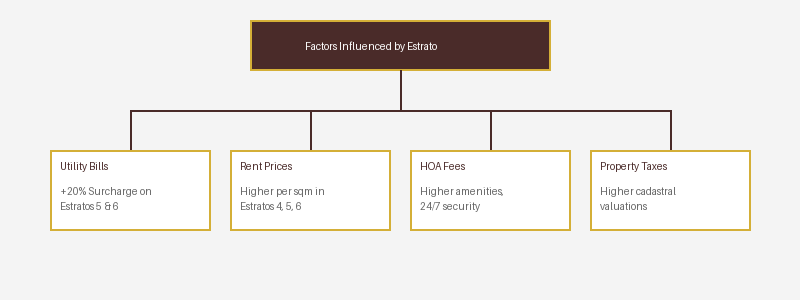
Although Law 142 specifically governs public utilities, estrato indirectly influences almost every financial metric associated with a real estate asset.
A. Rental Pricing
Estrato does not legally cap or set rent prices—the free market determines rent based on supply, demand, and property condition. However, properties in Estratos 4, 5, and 6 command significantly higher rent per square meter due to superior location, security, and building amenities.
B. HOA Administration Fees (Administración)
Buildings in Estratos 5 and 6 typically feature extensive common areas—such as 24-hour doorman security (portería), elevators, swimming pools, fitness centers, and underground parking. As a result, monthly HOA administration fees in Estratos 5 and 6 are higher than in Estratos 3 or 4.
C. Municipal Property Taxes (Impuesto Predial)
Municipalities use estrato alongside property size and location to determine cadastral valuations (avalúo catastral). Higher-estrato properties generally carry higher annual property tax rates.
4. Strategic Investor Blueprint: Which Estrato Should You Target?
The Investor “Sweet Spot”: Estrato 4
For investors prioritizing high net rental yields and lower holding costs, Estrato 4 (found in neighborhoods like Laureles, Estadio, and central Envigado) offers a distinct financial advantage:
- No Surcharges: Tenants and owners pay standard utility rates without the +20% solidarity tax.
- Broader Tenant Pool: Appeals to both long-term local professionals and foreign digital nomads seeking authentic, walkable neighborhoods.
- Lower Overhead: HOA administration fees and property tax rates are generally more moderate than in Estrato 6 towers.
The Luxury & Short-Term Rental Play: Estratos 5 & 6
For buyers focused on luxury living, high-end long-term corporate leases, or licensed short-term rentals (vacation stays), Estratos 5 and 6 (primarily located in El Poblado and upper Envigado) remain the dominant choice:
- Premium Nightly Rates: Furnished short-term rentals in Estrato 6 sectors (like Provenza or El Tesoro) command the highest daily rates in the city, easily offsetting the 20% utility surcharge.
- Capital Appreciation: Prime Estrato 6 corridors consistently show strong long-term property value growth driven by international demand.
5. Buyer & Renter Checklist: Verifying the Estrato Before Closing
- Check the Recent EPM Invoice: Before signing a lease or purchase contract, ask for a copy of the property’s most recent utility bill. The official municipal stratum is printed directly on the front page.
- Review the Title Certificate (Certificado de Tradición y Libertad): Verify that the property details match the municipal tax records.
- Calculate Consolidated Carrying Costs: Always evaluate a property by adding together Rent/Mortgage + Monthly HOA Fee + Utility Estrato Tier. A lower rent price in an Estrato 6 building can sometimes end up costing more per month than a higher rent price in an Estrato 4 building once utilities and HOA fees are factored in.
At Florece Real Estate, our team provides comprehensive financial modeling for every property transaction in Medellín and Antioquia. Whether you are balancing utility overhead for an investment portfolio or looking for your ideal home, we ensure you navigate Colombia’s real estate market with complete financial clarity.

Leave a Reply