
For expatriate and relocating families, choosing a school in Medellín is intimately tied to where you choose to live. The Aburrá Valley’s dramatic mountainous topography, micro-climates, and peak-hour traffic corridors mean that selecting an educational institution without considering geography can result in daily commutes exceeding two hours.
Medellín’s private education landscape is broader and more academically rigorous than many arriving families expect. Alongside established American-curriculum academies, the metropolitan area hosts premier European diplomatic schools, International Baccalaureate (IB) World Schools, and bilingual institutions that prepare students for top global universities.
Understanding how curricula, academic calendars, admissions protocols, and transit routes interact is essential to making an informed relocation decision.
1. Curricula & Language Tracks: Finding the Right Academic Fit
Expat families generally gravitate toward three primary academic frameworks in the metropolitan area:
North American & Dual-Track Academies
These institutions mirror U.S. college-preparatory environments, offering high levels of English immersion, Advanced Placement (AP) courses, and dual diplomas (U.S. High School Diploma and Colombian Bachillerato).
- The Columbus School (TCS): Located high in the mountains along the Alto de Las Palmas corridor, TCS is the premier choice for American curriculum immersion. Accredited by Cognia, it features a 54-acre collegiate campus and an extensive international faculty.
- The New School: Situated in Upper El Poblado (Loma de El Chocho), this school offers an intimate, student-centered campus with Cognia accreditation, strong arts integration, and an American dual-track curriculum.
European Diplomatic & Multilingual Institutions
Families seeking a European multilingual foundation have exceptional, state-supported options in Antioquia:
- Lycée Français de Medellín: Located along Loma del Escobero near the border of Envigado and El Retiro, the Lycée is part of the global AEFE network (Agence pour l’enseignement français à l’étranger). It follows the official French National Education curriculum, leading to the prestigious French Baccalauréat, with trilingual instruction in French, Spanish, and English.
- Deutsche Schule Medellín (Colegio Alemán): Located in the Ditaires sector of Itagüí, the German School is an officially recognized German School Abroad (Deutsche Auslandsschule). It provides immersive German-language education from kindergarten onward, culminating in both the Colombian diploma and the Gemischtsprachiges Internationales Baccalaureate (GIB) / Abitur track, with students graduating fully trilingual in German, Spanish, and English.
International Baccalaureate (IB) & Values-Based Programs
- Colegio Montessori: Positioned in El Poblado’s Loma de Los Balsos, Montessori is an established IB World School. It combines early childhood self-directed learning with the rigorous IB Diploma Programme (DP) in secondary school.
- Colegio Marymount Medellín: Located in Loma de Los Balsos, Marymount pairs Catholic values and Cognia-accredited English bilingual education with international exchange programming.
- Colegio Cumbres: Situated on Loma del Escobero in Envigado, Cumbres provides strong values-based bilingual instruction with competitive rankings on national university entrance exams (Saber 11).
2. Calendario A vs. Calendario B: Navigating School Cycles
Colombia operates on two official school calendars, both regulated by the Ministry of National Education (Ministerio de Educación Nacional):
- Calendario B (August to June): Aligns with the Northern Hemisphere academic year (United States, Canada, and Europe). Classes start in mid-August and conclude in early June, with a winter break from mid-December to mid-January.
- Calendario A (January to November): The traditional South American academic year. Classes begin in late January and end in late November, with the primary summer break falling across December and January.
| Calendar | School Year Runs | Ideal For | Prominent Examples |
| Calendario B | Mid-August – June | Families relocating from North America/Europe; students planning to attend Northern Hemisphere universities. | The Columbus School, Lycée Français, Colegio Montessori, Marymount, The New School, Colegio Vermont |
| Calendario A | Late January – November | Families prioritizing traditional European calendar exceptions or regional integration. | Deutsche Schule Medellín (Colegio Alemán), Colegio San José de Las Vegas |
Strategic Note: While most expat-oriented schools follow Calendario B, notable exceptions like Colegio Alemán operate on Calendario A. Plan your physical relocation and transition dates accordingly.
3. The Real Estate Connection: Mountain vs. Valley Logistics
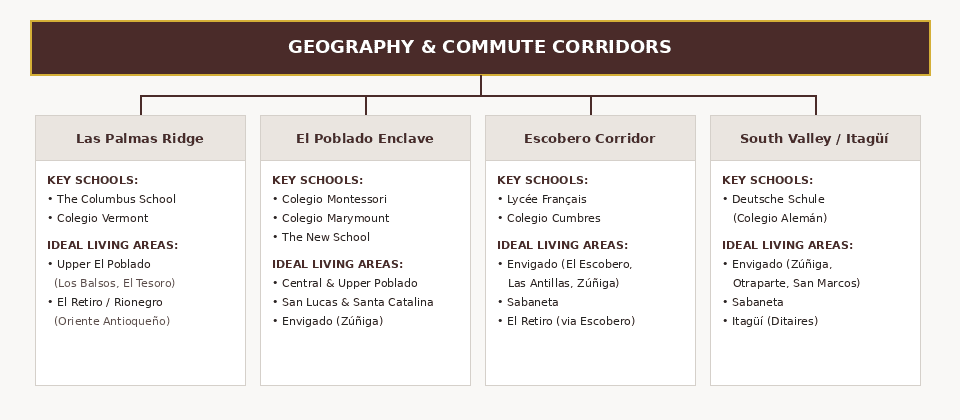
Medellín sits in a narrow river valley flanked by steep Andean ridges. Because many of the top international schools are located either high on mountain ridges (Las Palmas, Escobero) or outside the central municipality entirely (Envigado, Itagüí, El Retiro), school selection must dictate residential scouting.
The School Bus (Ruta Escolar) Reality
The majority of international school students utilize private school bus routes (rutas escolares).
- Valley-to-Mountain Congestion: If you reside in Laureles or lower El Poblado and your child attends an institution on Las Palmas or upper Escobero, morning bus rides can easily reach 60 to 75 minutes due to uphill traffic.
- The Envigado / Upper Poblado Advantage: Families residing in Upper El Poblado (Los Balsos, San Lucas) or Envigado (Zúñiga, El Escobero) cut daily transit times down to 15 to 25 minutes.
- Eastern Antioquia (Oriente): Relocating families prioritizing sprawling land and single-family homes often choose to live in El Retiro or Rionegro, placing them within minutes of The Columbus School, Lycée Français, and Vermont while bypassing city traffic entirely.
Before finalizing a home purchase or lease, always obtain written confirmation from the school’s transport department verifying that your specific building or gated community (unidad cerrada) sits within their official pickup perimeter.
4. School Comparison Matrix
| School | Primary Curriculum | Language(s) of Instruction | Calendar | Campus Location | Recommended Residential Enclaves |
| The Columbus School | U.S. High School Diploma + AP / Colombian | English (80%+) & Spanish | B | Alto de Las Palmas | Upper Poblado, Envigado, El Retiro |
| Lycée Français de Medellín | French National Curriculum (AEFE) / Baccalauréat | French, Spanish, English | B | Loma del Escobero (El Retiro) | Envigado (Escobero), El Retiro, Poblado |
| Deutsche Schule Medellín | German Abitur / GIB & Colombian | German, Spanish, English | A | Itagüí (Ditaires) | Envigado (Zúñiga/Otraparte), Sabaneta |
| Colegio Montessori | IB Diploma Programme (DP) & Colombian | English & Spanish | B | El Poblado (Los Balsos) | El Poblado, Envigado (Zúñiga) |
| Colegio Marymount | Cognia U.S. Dual-Track & Colombian | English & Spanish | B | El Poblado (Los Balsos) | Central & Upper El Poblado |
| The New School | Cognia U.S. Accredited / Progressive Arts | English & Spanish | B | El Poblado (Loma El Chocho) | Upper Poblado, Northern Envigado |
| Colegio Cumbres | Semper Altius / Cambridge English | English & Spanish | B | Envigado (Loma del Escobero) | Envigado, Sabaneta |
5. Tuition, Fees, and the “Bono” Financial Model
Private schooling in Medellín provides exceptional value relative to private day schools in North America and Western Europe, but fee structures differ significantly:
- The Admission Bond (Bono de Ingreso / Aporte Familiar): Many elite private institutions require a one-time capital donation upon acceptance. This fee is non-refundable and ranges between $2,000 and $8,000 USD per family or child.
- Annual Registration (Matrícula): Paid once per academic year prior to the start of the term, typically equivalent to one month of tuition.
- Monthly Tuition (Pensión): Billed across 10 or 11 installments. Tuition at premier international and bilingual schools generally ranges between $600 and $1,500 USD per month, scaling upward with the student’s grade level.
- Transport and Dining (Ruta y Alimentación): Mandatory or optional monthly operational fees for door-to-door bus transit and campus meal plans typically total between $150 and $300 USD per month.
6. Required Documentation for Expat Student Admissions
Securing admission for international students requires careful document preparation, ideally started 3 to 6 months prior to relocation:
- Apostilled Academic Records: Official report cards and transcripts covering the last 2 to 3 academic years must be notarized and stamped with an official Apostille from the issuing country or state department of education.
- Certified Spanish Translations: Transcripts in languages other than Spanish must be translated by an officially licensed translator (traductor oficial) in Colombia.
- Equivalency Validation (Convalidación): For students entering 6th grade and above, international academic records must undergo administrative validation with the Colombian Ministry of Education to certify grade parity.
- Residency Verification: Copies of the child’s passport, Colombian residency visa (such as an M-10 Real Estate Investor Visa or Digital Nomad Visa), and the child’s Cédula de Extranjería (foreigner ID).
- Character & Financial Clearances: Letters of good conduct from the applicant’s previous school, alongside proof of parent financial solvency (paz y salvo).
At Florece Real Estate, our Family Relocation Advisory aligns your school admissions process directly with your property search. Whether your children thrive in a French immersion environment, a German curriculum, or an American college-preparatory academy, we ensure your family finds an exceptional home with an effortless daily commute.

Leave a Reply